 Hoya Habit
Care guide
Green velvet alocasia (Alocasia micholitziana 'Frydek')
Also called Alocasia Frydek, Frydek elephant ear, Velvet elephant ear. Family Araceae.

At a glance
- Light
- Bright, indirect light; copes with some direct sun and medium light.
- Water
- When the top third of the mix has dried. Check the soil first.
- Soil
- A chunky mix that holds some moisture but never stays wet: roughly two parts peat-free houseplant compost to one part fine orchid bark and one part perlite or horticultural grit.
- Pot
- A drainage hole is a must; likes to be snug; go up 2 to 5 cm at a time.
- Temperature
- 18 to 27 C; not below 16 C.
- Humidity
- 50 to 70%; dry rooms need help.
- Feeding
- Half strength every 2 to 4 weeks in the growing season, none in the rest months.
- Repotting
- Every 2 to 3 years, in spring.
- Rest
- Late autumn to late winter: cooler, drier, unfed.
- Flowers
- Rarely indoors; grown for its leaves.
- Pets and people
- Cats toxic, dogs toxic, people toxic.
- Difficulty
- Moderate.
Before you waterPush a finger 3 to 5 cm into the mix and lift the pot. Dry at that depth and clearly lighter than after a watering means water; damp means wait a day or two and check again.
Meet the plant
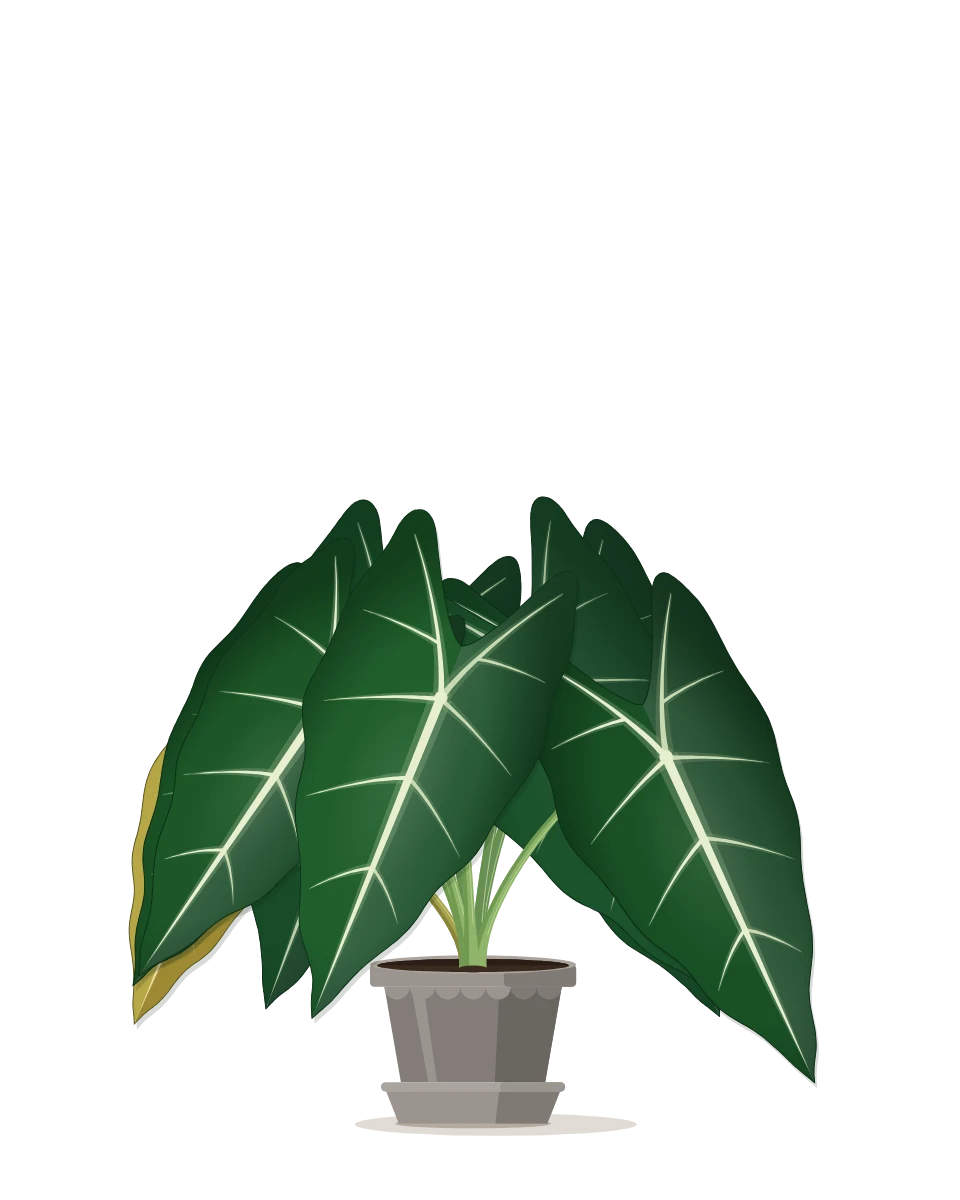
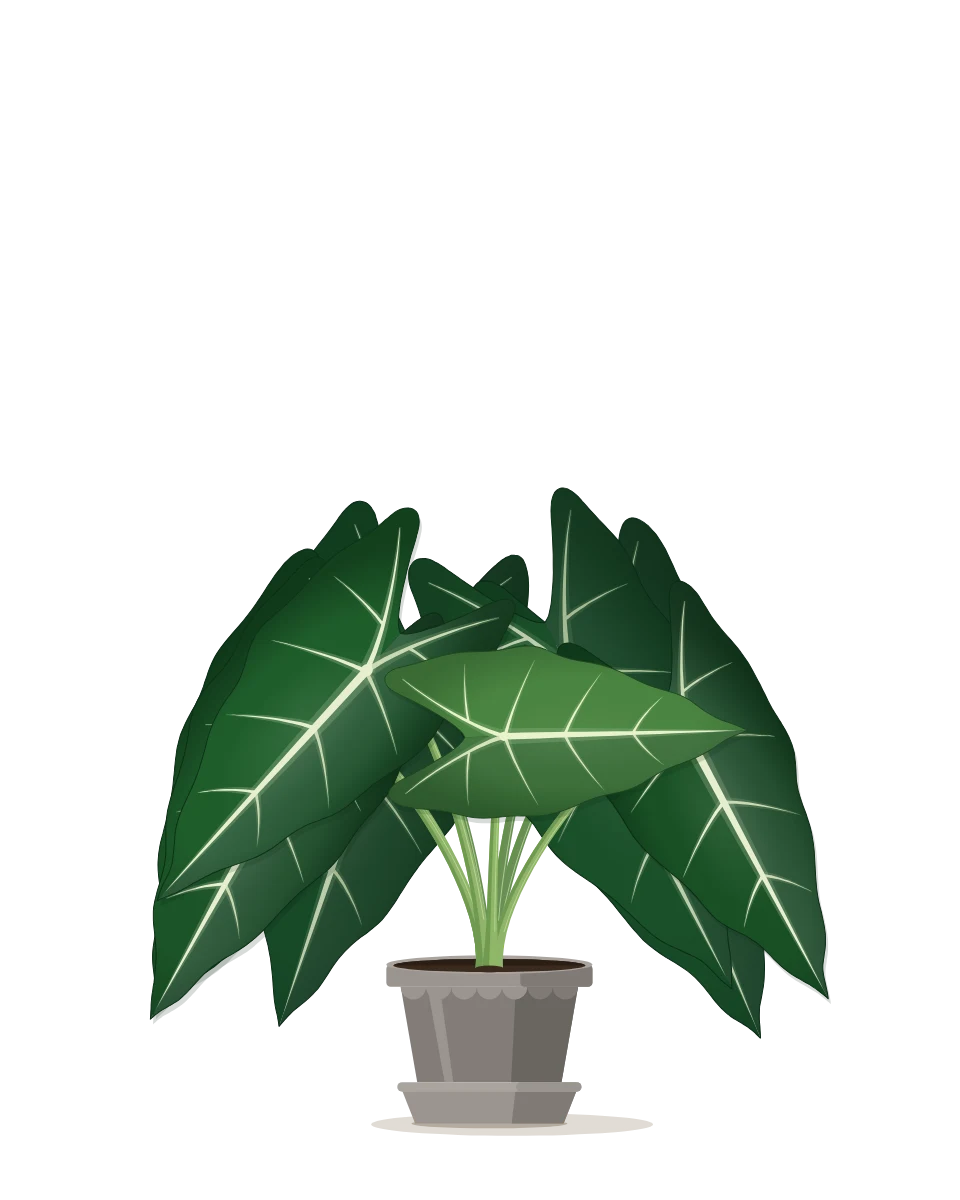
A crown of long arrowhead leaves on pale stalks, each leaf a deep green velvet with thick white veins, standing up and out from a corm at the soil (NC State Extension, RHS profile). The species comes from Luzon in the Philippines (IPNI), from the warm, wet floor of the forest, and 'Frydek' is its usual form in cultivation; the names 'Frydek' and 'Green Velvet' are used for the same plant (Epic Gardening). A grown leaf is up to 40 cm long on a stalk up to 45 cm, with a gently wavy edge, and a mature plant stands 50 cm to a metre tall and as wide (RHS profile, RHS 'Freydyk' profile). Sources differ on the underside of the leaf: the RHS says pale green, NC State says burgundy; plants in the shops are usually pale underneath.
It is a plant of warmth and humidity, and it is honest about both. Pistils Nursery calls alocasias finicky plants that often drop leaves or go dormant (Pistils Nursery); Logee's calls 'Frydek' an easy, strong grower that resists the winter decline of other alocasias (Logee's); the RHS calls it slow and compact (RHS 'Freydyk' profile). This guide calls it moderate: steady while it is warm, bright and evenly watered, with two things that catch people out, spider mites and a winter rest that can look like death. Every part of it holds calcium oxalate crystals. The ASPCA lists the genus as toxic to cats, dogs and horses (ASPCA), and NC State and the RHS list it as poisonous if eaten and an irritant to skin and eyes (NC State Extension, RHS profile). Keep it out of reach, and wear gloves when you cut it.
The plant you buy is small: a young plant from tissue culture or a divided corm, in a 10 cm pot, with one or two leaves (Logee's, Wisconsin Extension). Young leaves open a bright lime green and darken to velvet as they harden (Logee's). It makes one leaf at a time, each a little larger than the last, and once the crown holds as many leaves as the pot can feed, the oldest yellows and goes as each new one opens. What to expect in a year: a crown of four to six leaves by autumn, the newest perhaps 30 cm long, and then a pause for the winter, in which it may hold its leaves, lose a few, or lose them all and wait as a corm. The RHS gives it two to five years to reach full size (RHS 'Freydyk' profile).
Light
Bright, indirect light: close to an east or west window, or back from a south one, with no hot sun on the leaves (RHS growing guide, Proven Winners). Costa Farms puts it within a metre or so of an unobstructed east or west window and says medium light will do (Costa Farms). An hour or two of gentle morning sun is fine; Epic Gardening keeps direct sun under two hours a day (Epic Gardening). Outdoors the genus grows in dappled or partial shade (NC State Extension, Illinois Extension), and a window is brighter than it looks to us, so the cautious path is bright light with the sun filtered.
Too much sun shows as pale, bleached or crisp patches on the leaves nearest the glass; the velvet scorches easily (RHS growing guide, Epic Gardening). Too little shows as slower and slower growth, smaller new leaves, and in winter a plant that stops and drops its leaves: low light is one of the things that sends an alocasia dormant (RHS growing guide, Highland Moss). Turn the pot a little at each watering so it does not lean toward the window (RHS growing guide).
Water
Check first. Push a finger 3 to 5 cm into the mix and lift the pot (RHS growing guide, Proven Winners). Dry at that depth and clearly lighter than after a watering means it is time. Damp means wait a day or two and check again. The leaves help: leaves that droop on their stalks and lose their sheen are usually asking, but drooping comes from wet roots too, so the finger decides, not the leaf.
The rule: water thoroughly, until it runs out of the bottom, once the top third of the mix has dried, and empty the saucer so the pot never stands in water (Proven Winners, RHS growing guide). This is a shallower dry-down than a hoya or a succulent gets: the plant wants to stay lightly moist below the surface (Illinois Extension), and a pot left bone dry for a week or two makes it drop leaves and go dormant. Sources differ on exactly how far to let it dry: the RHS says the top 5 cm, Proven Winners the top 5 to 7 cm, Epic Gardening the top 2 to 5 cm, Costa Farms the top quarter to half of the mix (RHS growing guide, Proven Winners, Epic Gardening, Costa Farms). This guide takes the top third, the drier end of what they agree on, because the roots are sensitive to rot and a corm that rots does not come back (Costa Farms). Use room-temperature water.
Thirsty: leaves drooping and dull, edges yellowing, tips browning, the oldest leaves going first, on a dry light pot (Epic Gardening). A thorough watering brings a drooping plant back within a day or two. Overwatered: leaves yellowing while the mix is still wet, stalks soft at the base, fungus gnats around the pot, and eventually a soft corm (NC State Extension, Proven Winners). If the leaves say thirsty and the mix says wet, believe the mix and look at the roots.
How often that lands depends on the pot, the mix, the light and the room. In a small pot in a warm, bright room in summer it often comes round every five to ten days, and Costa Farms simply says to check it weekly (Costa Farms); in winter, when growth stops, every two or three weeks is usual, and a dormant corm with no leaves wants only enough to keep the mix from drying out completely. No source gives a number; the ranges are a reminder to go and check, not the instruction. In winter the RHS reduces watering to a minimum, because overwatering a dormant plant rots the roots (RHS growing guide), while Proven Winners says never let the container dry out completely (Proven Winners). Both are right: barely moist, never wet, never dust dry.
Soil and pot
A chunky mix that holds some moisture and still drains freely. Start with a peat-free houseplant compost and add about a third of grit, perlite or orchid bark; the RHS uses three parts compost to one of grit, Proven Winners a well-draining mix that retains moisture, amended with orchid bark, perlite or coco coir, and Epic Gardening equal parts compost, perlite, bark and worm castings (RHS growing guide, Proven Winners, Epic Gardening). Aroid growers go chunkier, with bark and perlite in every handful, because aroid roots rot when they sit in water (Pistils Nursery). Plain potting compost on its own compacts and stays wet. Slightly acid to neutral suits it (NC State Extension).
The pot needs a drainage hole and should be snug. The plant does well slightly pot-bound, and a pot too large holds water the corm cannot use (Proven Winners, Epic Gardening). When you move up, go one size, 2 to 5 cm wider and a little deeper (RHS growing guide, Proven Winners). Plastic or a nursery pot inside a cachepot keeps the mix evenly moist and lets you judge the weight; terracotta dries faster and suits a heavy hand with the watering can; the RHS likes a heavy pot for a tall plant so it does not tip (RHS growing guide).
Repot in spring, as new growth starts, and only when roots show at the drainage hole or fill the pot, or the mix dries far faster than it used to (Proven Winners, RHS growing guide). A new plant can stay in its pot for the first year; after that every two or three years is usual (RHS growing guide, Epic Gardening). Set the corm at the depth it was, with the top of the root ball just below the surface, trim any dark soft roots, and water it in lightly so the mix settles; then no feed for about three months (Proven Winners). Never repot a dormant plant; wait for leaves (Highland Moss).
Feeding
A balanced liquid houseplant feed at half strength every two to four weeks from spring to early autumn, while leaves are coming (Proven Winners). Nothing from late autumn to late winter, and nothing at all while the plant is dormant (Proven Winners, Epic Gardening). Sources disagree on how much: the RHS feeds at the label rate every two to three weeks and Illinois Extension calls the genus a heavy feeder that wants feeding every fortnight (RHS profile, Illinois Extension), while Epic Gardening feeds monthly and Pistils warns that aroid roots burn easily (Epic Gardening, Pistils Nursery). This guide takes the weaker dose at the shorter interval: little and often does what a heavy feeder needs without burning the roots. Flush the pot with plain water every couple of months to wash out salts, and wait about three months after a repot.
Flowering
Indoors it rarely flowers, and when it does the flower is a small greenish spathe tucked under the leaves, easy to miss and of no account (RHS profile, NC State Extension). This is a leaf plant; its reward for good care is the next leaf, bigger than the last.
When something looks wrong
Look at the soil first, then at the season. A velvet alocasia says most things by drooping or by yellowing a leaf, and the same symptom can mean too dry, too wet, or simply winter.
- Drooping. Check the mix. Dry 5 cm down and light: water thoroughly, and the leaves usually lift within a day or two. Wet: hold off, let the top third dry, and if the stalks are soft at the base slide the plant out and look at the roots (Epic Gardening). Cold glass, a draught, or a recent move also droop it; give a moved plant a week or two.
- The oldest leaf yellowing as a new one opens. Normal. The plant keeps a fixed number of leaves and lets the oldest go. Cut it at the base once it has gone, with gloves and clean scissors, and leave the rest alone (Proven Winners).
- Several leaves yellow at once, mix wet. Overwatering, a pot too large or without a hole, or cold wet mix in winter (NC State Extension, Epic Gardening). Stop until the top third is dry, make sure water can leave the pot, and look at the corm: firm means it will recover, soft means rot.
- Brown crispy edges and tips. Dry air first, then thirst, then salts from too much feed, then sun (RHS growing guide, Costa Farms, Pistils Nursery). Raise the humidity, check the mix, flush the pot and feed less.
- Pale or bleached patches on the window side. Sun. Move it back or filter the light; the marks stay, the next leaf comes clean (RHS growing guide, Epic Gardening).
- Leaves dropping one after another in autumn or winter. Dormancy. Short days, a cool room or a dry spell tell the plant to shut down; the leaves yellow, brown and fall, and the plant can look dead (Highland Moss, RHS growing guide). Feel the corm through the mix: firm means resting. Keep it warm, above 16 C, in bright indirect light, barely moist and unfed, do not repot it, and wait; leaves usually return in spring, and under good conditions within a month or two (Highland Moss, Proven Winners). Do not throw away a pot with a firm corm in it. A soft, smelly corm has rotted.
- No new leaf for weeks. Winter, a cool room, dim light, or a pot the roots have filled (RHS growing guide). Warmth and light are what start it again; check the roots in spring.
- New leaves smaller than the last. Too little light or too little food, or crowded roots (RHS growing guide, Highland Moss). Move it nearer the window, feed lightly in season, repot in spring if needed.
- Spider mites. Its signature pest, worst in warm dry air near winter heating: fine tan speckling, leaves going dull and greyish, faint webbing under the leaves and in the leaf joints (NC State Extension, RHS growing guide). Tap a leaf over white paper and watch for moving specks (Iowa State Extension). Shower the plant, undersides included, every few days, then spray with insecticidal soap or horticultural oil, undersides thoroughly, and repeat weekly for a few weeks, because the sprays only kill what they touch (Iowa State Extension). Test any spray on one leaf first; the velvet can mark. Raise the humidity and keep the plant apart until clear; a stressed plant gets mites first (Proven Winners).
- Mealybugs or aphids. White cottony tufts in the leaf joints, or small green insects on the newest leaf (NC State Extension, RHS profile). Dab mealybugs with a cotton bud in rubbing alcohol, wash the plant with mild soapy water or insecticidal soap, repeat weekly, and look inside the sheath where the new spike rises.
- Fungus gnats. Tiny black flies around the pot mean the mix never dries (Proven Winners). Let the top third dry between waterings; a Bacillus thuringiensis israelensis drench clears the larvae.
- Spots spreading across a leaf. Leaves left wet without airflow, or a plant kept too wet (NC State Extension, Epic Gardening). Water the mix, not the leaves, stop misting, remove the worst leaves and let air move.
- Dark mushy stalk bases, soft corm. Rot from wet mix or an oversized pot. Cut away every dark soft root and any soft part of the corm with a clean knife, let the cuts dry for a day, and repot in fresh, barely moist mix in a snug pot (Epic Gardening, Proven Winners). Pot up any firm offsets separately in case the mother does not recover.
Propagation
From the corm, not from cuttings. A settled plant sends up offsets beside the mother, small corms with a leaf or two of their own, and small cormels form on the sides of the main corm (RHS growing guide, Wisconsin Extension). In spring, when growth starts, slide the plant out, wear gloves, and separate the offsets with as much root as they have, or divide the rhizome with a clean knife, and pot each piece in the gritty mix in a small pot (RHS growing guide, NC State Extension). Keep them warm, bright and lightly moist until shoots appear, which can take a few weeks. A loose corm with no leaf can be set in a shallow dish of water with its top above the surface, covered with a glass, in bright indirect light; it usually sprouts within a month, and goes into mix once the shoot is a few centimetres tall (Epic Gardening). Do not divide a dormant plant; wait for leaves.
The RHS lists stem cuttings in spring for this species (RHS profile), but a houseplant has no stem to cut above the corm and Epic Gardening says it does not root from cuttings (Epic Gardening); offsets and division are the way. Many plants in the shops come from tissue culture and may not have formed a corm yet (Wisconsin Extension), so give a young plant a year or two before you expect pups.
Grow one for a habit
In Hoya Habit, every habit you keep grows a plant of its own. Check in and it leafs out; let it slide and the plant shows it. Give one of your habits a Alocasia micholitziana 'Frydek'.
Sources
- RHS, How to grow alocasias, read 2026-10-21
- RHS, Alocasia micholitziana plant profile, read 2026-10-21
- RHS, Alocasia micholitziana 'Freydyk' plant profile, read 2026-10-21
- NC State Extension, Alocasia, read 2026-10-21
- ASPCA, Alocasia, read 2026-10-21
- Illinois Extension, Alocasia, read 2026-10-21
- University of Wisconsin-Madison Extension, Elephant ears (Colocasia, Alocasia and Xanthosoma), read 2026-10-21
- IPNI, Alocasia micholitziana Sander, read 2026-10-21
- Logee's, Alocasia 'Frydek', read 2026-10-21
- Proven Winners, Alocasia growing guide, read 2026-10-21
- Iowa State University Extension, Spider mites, read 2026-10-21
- Epic Gardening, How to plant, grow and care for Alocasia Frydek, read 2026-10-21
- Pistils Nursery, All about Araceae, read 2026-10-21
- Costa Farms, Alocasia Polly, read 2026-10-21
- Highland Moss, Everything you need to know about Alocasia dormancy, read 2026-10-21