 Hoya Habit
Care guide
Chinese money plant (Pilea peperomioides)
Also called Pilea, Pancake plant, Missionary plant, UFO plant, Friendship plant. Family Urticaceae.
At a glance
- Light
- Bright, indirect light; copes with medium light.
- Water
- When the top half of the mix has dried. Check the soil first.
- Soil
- A free-draining peat-free houseplant mix with a quarter to a third perlite or pumice added, so water runs through and air reaches the roots.
- Pot
- A drainage hole is a must; a size wider than the roots is enough; go up 2 to 5 cm at a time.
- Temperature
- 18 to 24 C; not below 13 C.
- Humidity
- 40 to 60%; ordinary room air is fine.
- Feeding
- Half strength every 4 to 8 weeks in the growing season, none in the rest months.
- Repotting
- Every 2 to 3 years, in spring.
- Rest
- Late autumn to late winter: cooler, drier, unfed.
- Flowers
- Rarely indoors; grown for its leaves.
- Pets and people
- Cats not listed, dogs not listed, people not listed.
- Difficulty
- Easy.
Before you waterPush a finger a few centimetres into the mix and lift the pot. Dry and light means water; damp or heavy means wait a few days and check again.
Meet the plant
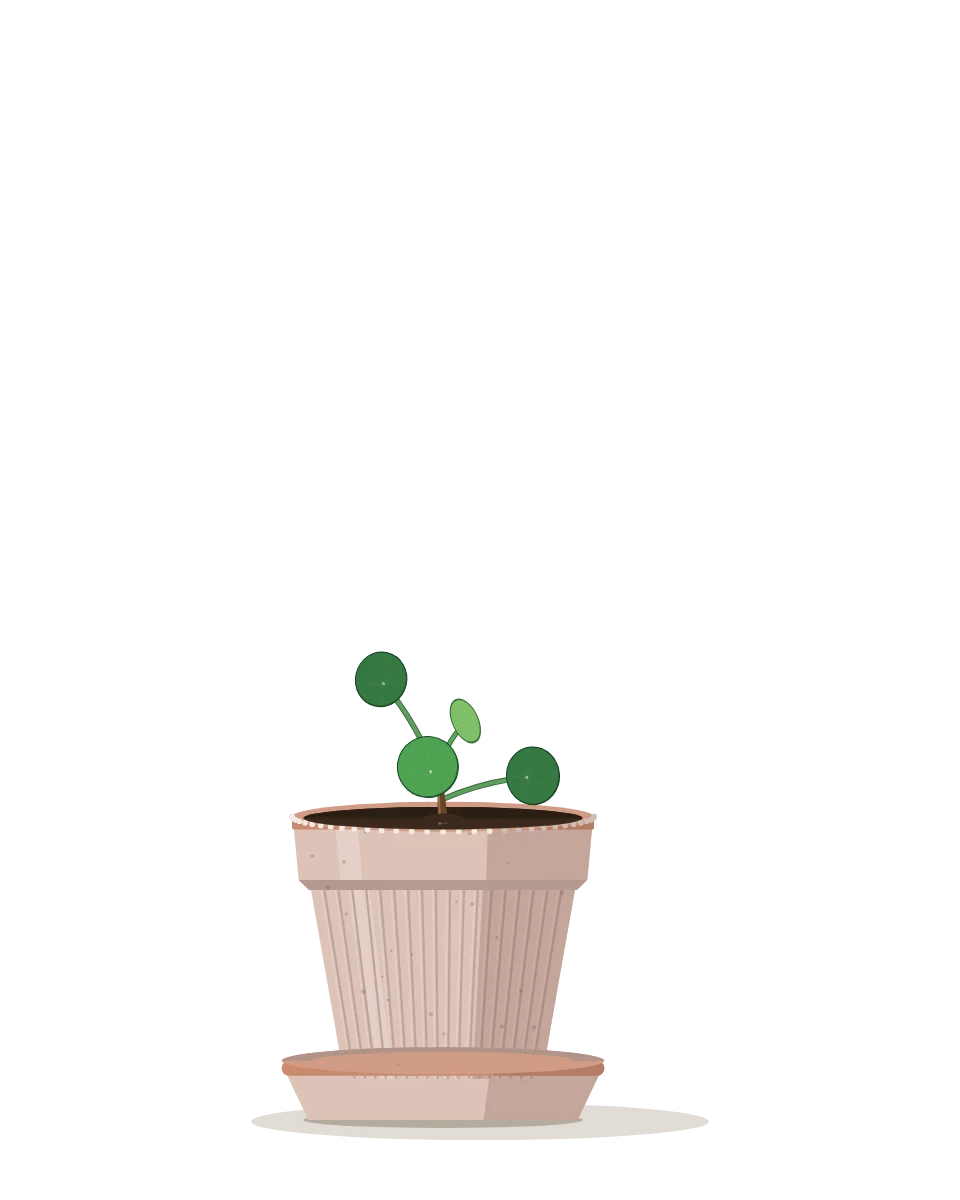
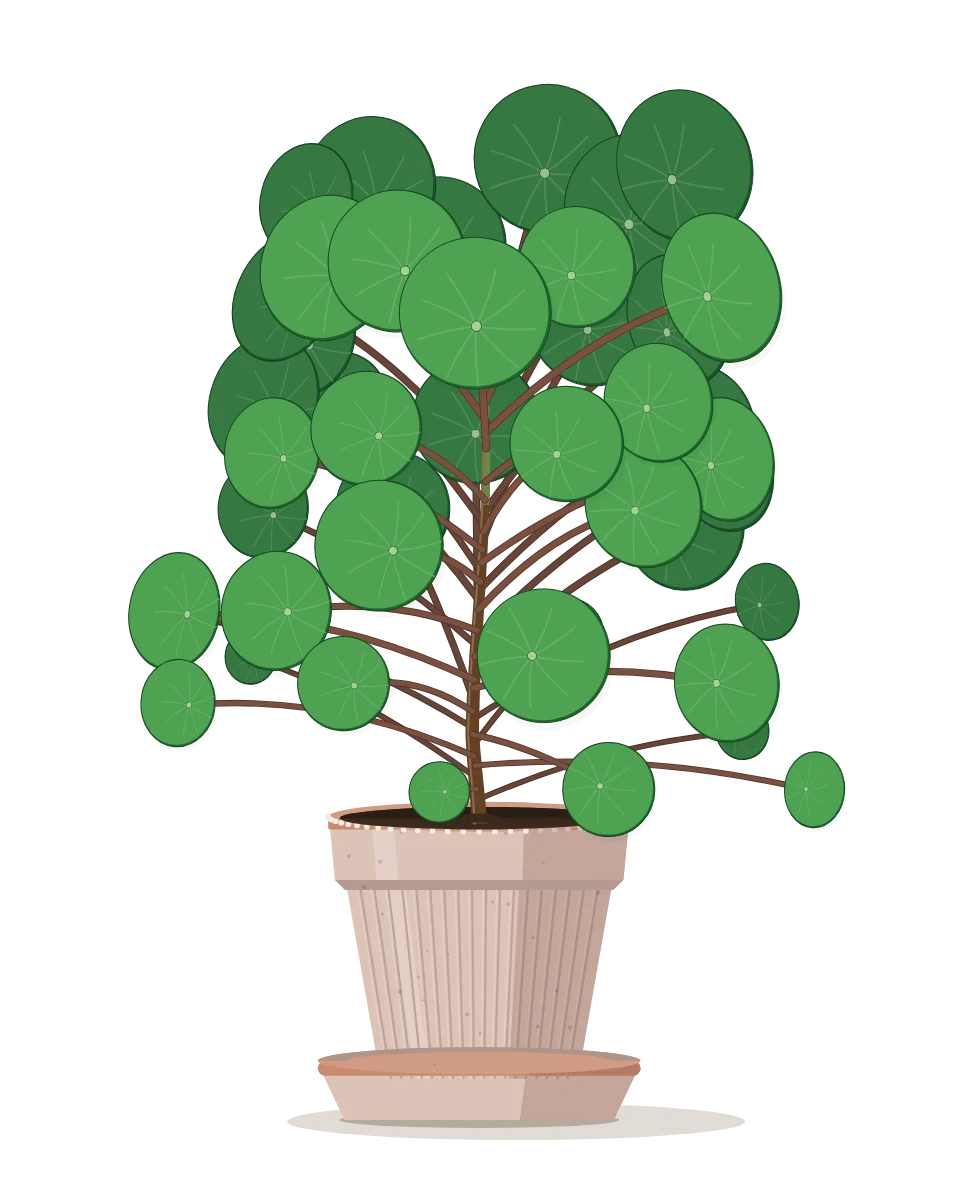
A small upright plant with round, glossy leaves on long stalks, each one held like a coin on a stick. It comes from the mountains of Yunnan in south-west China, where it grows on shaded, moist rocks in forests at 1,500 to 3,000 m (Flora of China). It reached Europe without a nursery: a Norwegian missionary carried cuttings home in 1946, and for decades it travelled from windowsill to windowsill as a pup given to a friend, which is why it is also called the friendship plant or the pass-it-on plant (Laidback Gardener). The RHS gives it an Award of Garden Merit (RHS profile).
It stays compact, about 20 to 30 cm tall and wide, and the base of the stem turns woody with age (NC State Extension, RHS profile). It grows quickly in spring and summer, slows right down in winter, and sooner or later sends up small plants, pups, from the soil around its base. Every source that mentions difficulty calls it easy and forgiving (Gardeners' World). Its one weakness is wet feet. It is safe to keep around pets and children: NC State Extension says so, and the ASPCA lists its close relatives, such as the aluminium plant, as non-toxic to cats and dogs, though it has no entry for this species itself.
What to expect in a year: a young plant roughly doubles in size, a new leaf every week or two in the growing season, the lowest leaves yellowing and dropping now and then as it gains height, and, after a few months of settled care, the first pups.
Light
Bright, indirect light: a short distance from a window, or behind a sheer curtain, with no sun falling on the leaves (NC State Extension, Penn State Extension). The RHS places it near a north, east or west window, and in a south-facing room back from the glass, especially in summer (RHS, How to grow pilea); a north window in a bright room can be enough, a north window in a dim one is not. A few growers report that an hour or two of gentle morning sun keeps it compact; the extension pages say no direct sun, and this guide follows them.
Too much sun shows as red-brown or pale, crispy patches on the leaves nearest the window (RHS, How to grow pilea, Gardeners' World). Too little shows as long stems with small leaves far apart, and a whole plant leaning toward the light (Penn State Extension, NYBG). It always grows toward the window, so turn the pot a quarter each time you water and the crown stays round (RHS, How to grow pilea).
Water
Check first. Push a finger a few centimetres into the mix and lift the pot (RHS, How to grow pilea). Dry and light means it is time. Damp or heavy means wait a few days and check again. The leaves help too: thin, soft leaves that have started to droop on their stalks are the plant asking for water, and when in doubt, wait a little longer (Pilea.com FAQ).
The rule: water when the top half of the mix has dried. Then water thoroughly, until it runs out of the bottom, and empty the saucer so the pot never stands in water (RHS, How to grow pilea, NYBG). Sources differ on how far to let it dry: the RHS says the top few centimetres, the New York Botanical Garden the top two-thirds. This guide takes the middle and leans dry, because a Pilea bounces back from thirst within a day and does not bounce back from rot.
Drooping comes from both directions, so a drooping plant is a reason to check the soil, not to water (Gardeners' World). Thirsty: leaves soft and sagging, mix dry well down, pot light. Overwatered: several leaves yellow and limp at once, soft stalks, leaves dropping, with the mix still wet (NYBG, Epic Gardening). Root rot from overwatering is the usual way a Pilea dies (Sprout Home, NC State Extension).
How often this lands depends on the pot, the mix, the light and the room. In a small pot in good light in summer it often comes round every week or two; in winter, when growth slows, every two or three weeks is usual and the plant wants less (RHS, How to grow pilea, Sprout Home, Pilea.com FAQ). Treat those numbers as a reminder to go and check, not as the instruction. Use room-temperature water, and in winter let the pot drain well so it does not sit in cold, wet compost (Gardeners' World).
Soil and pot
A free-draining mix. Start with a peat-free houseplant or soil-based compost and add a quarter to a third perlite or pumice, or mix it half and half with a cactus mix (Penn State Extension, RHS, How to grow pilea, Gardeners' World). Slightly acid to neutral is fine (NC State Extension).
The pot must have a drainage hole (NYBG); a layer of gravel at the bottom is no substitute. A plastic nursery pot inside a decorative one works well. Terracotta dries faster and forgives an extra watering. Choose a pot only a couple of centimetres wider than the roots: too much empty mix holds water the small roots cannot use, and that is how rot begins (RHS, How to grow pilea, Penn State Extension). Shallow pots are fine (NYBG).
Repot in spring, and only when the roots have filled the pot: roots at the drainage hole, a mix that dries far faster than it used to, growth slowing in good light. A new plant can stay in its pot for the first year; after that, every two or three years is usual (RHS, How to grow pilea). Go up one size. A few roots at the surface are normal and not a reason to repot.
Feeding
A balanced liquid houseplant feed at half strength, every month or two from spring to early autumn (RHS, How to grow pilea, Gardeners' World). Nothing from late autumn to late winter, when the plant is resting (NYBG). Sources disagree: the New York Botanical Garden feeds every other week at half strength, the RHS every month or two at the label rate, and one long-time grower not at all. The plant responds little to feed, and overfeeding browns the leaf edges and leaves white crusts on the soil, so this guide takes the weaker rule. Wait two or three months before feeding a newly potted pup (Folia Collective).
Flowering
Indoors it almost never flowers, and when an older plant does, the flowers are tiny pale green or pinkish beads on a thin spike, easy to miss (NC State Extension, RHS profile). This is a leaf plant. Its reward for good care is pups.
When something looks wrong
Look at the soil before you look for a disease. Most trouble on a Pilea is water.
- Drooping. Check the mix. Dry and light: water, and the leaves usually lift within a day. Wet: wait, and if the stalks are mushy, slide the plant out and look at the roots (Gardeners' World, Epic Gardening). Long drooping stems on a young plant mean too little light (NYBG).
- The lowest leaf or two yellowing. Normal ageing, more so in autumn. Remove them once they come away easily (NYBG).
- Several leaves yellow and limp at once, mix wet. Overwatering. Stop until the top half is dry and make sure water can leave the pot. If most leaves are yellow, slide it out, trim any dark soft roots and repot in fresh dry mix (Epic Gardening, Pilea.com FAQ).
- Curling. New leaves open curled and flatten by themselves. Mature leaves curling usually means too little light; it can also be too much or too little water, heat or a draught (RHS, How to grow pilea, NYBG). Fix the light first, then check the mix. The direction of the curl does not settle the cause on its own.
- Red-brown or bleached crispy patches on the window side. Sun. Move it back; the marks stay, new leaves come clean (RHS, How to grow pilea).
- Small white chalky dots under the leaves. Harmless mineral deposits, nothing to worry about. Wipe them with a warm damp cloth or leave them (NYBG, RHS, How to grow pilea). Fluffy white tufts that move are mealybugs, which is a different matter.
- Leggy and leaning. Too little light and a pot never turned. Move it to brighter indirect light and turn it at each watering. In spring, cut a leggy stem back to encourage growth from the base, or root the top as a cutting (RHS, How to grow pilea). A bare woody base on a plant a year or two old is simply what it looks like with age.
- Brown edges or tips. Dry air, thirst, or salts from too much feed. Check the mix, water through until it runs clear, feed less, and give it a pebble tray in a very dry room.
- Dark, soft stem at the soil line. Rot. Cut away every dark soft root with clean scissors and repot in fresh dry mix. If the stem itself is mushy it is usually past saving; root the healthy pups or the top instead (Epic Gardening).
- Mealybugs. Dab each one with a cotton bud dipped in rubbing alcohol, then wash the plant with mild soapy water or insecticidal soap, repeating weekly, and keep it apart from other plants until clear (University of Missouri Extension).
- Fungus gnats. Tiny black flies around the pot mean the compost stays damp. Let it dry out well between waterings; a Bacillus thuringiensis israelensis drench clears the larvae (University of Missouri Extension).
- Spider mites. Fine webbing and pale speckled leaves in hot, dry air. Shower the plant, undersides included, every few days, wash with soapy water or insecticidal soap, and raise the humidity around it (University of Missouri Extension).
Propagation
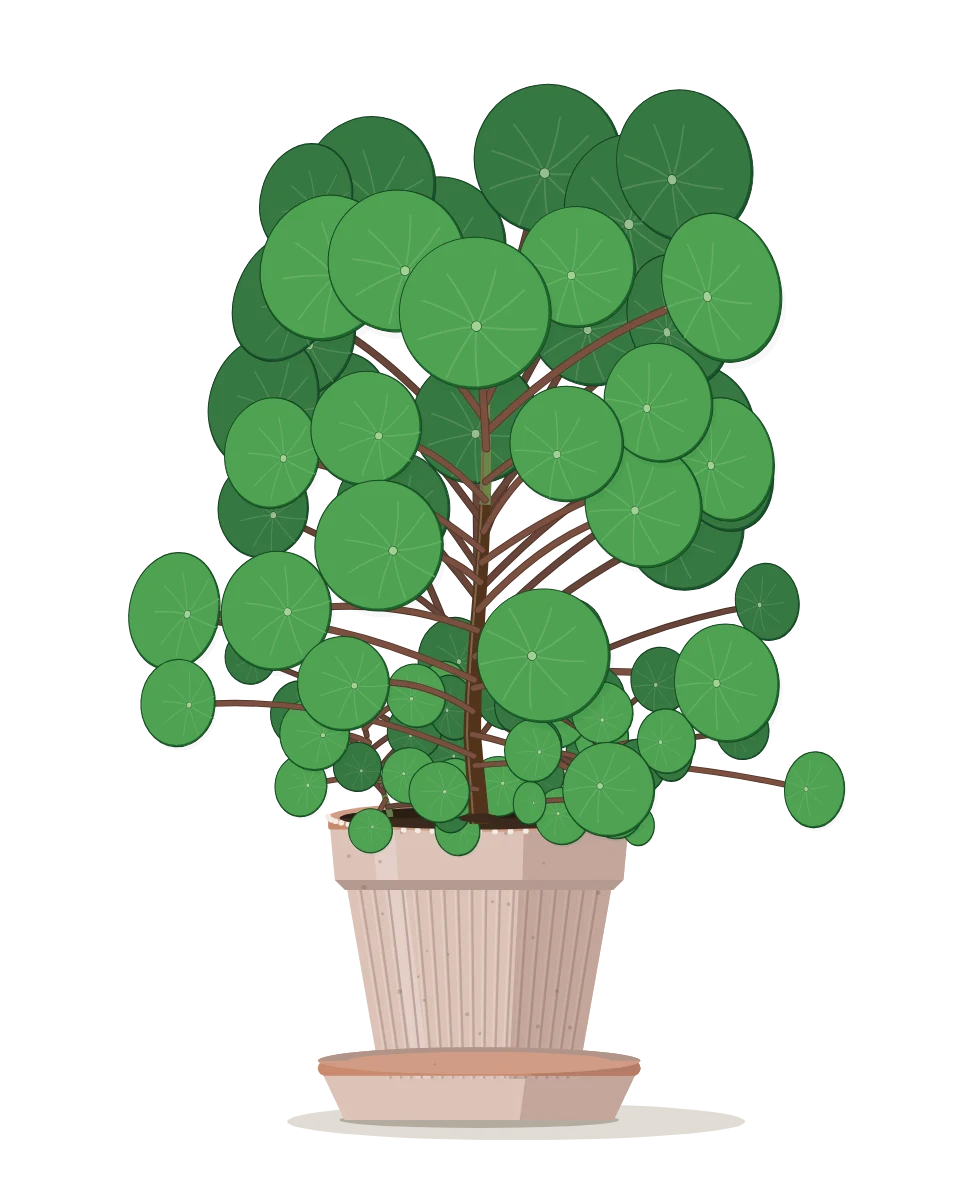
This is the sharing plant. A settled plant sends up pups from the soil around its base, and sometimes small plantlets straight from the stem (RHS, How to grow pilea, Penn State Extension).
Wait until a pup has three or four leaves of its own and stands 5 to 7 cm tall (Folia Collective). In spring or early summer, when the plant is growing, cut it free about a centimetre below the soil with a clean knife, keeping a piece of the underground stem and any roots it has (NC State Extension, Pilea.com FAQ). Do not pull it. A pup with roots goes straight into a small pot, 7 to 10 cm, of the same mix; one without roots sits in a glass of water with only the stem submerged and the leaves clear, and usually has roots in one to two weeks, three to five for a stem cutting, longer in winter (Folia Collective). Pot it up once the roots are a couple of centimetres long, keep it a little moist and out of sun for the first weeks, and do not feed it for two or three months.
A tip cutting from a leggy plant roots the same way. A single leaf on its own stalk is not enough to make a new plant: sources disagree on whether it roots, and even where it does, it needs a piece of stem to grow from. Take a cutting with stem.
Grow one for a habit
In Hoya Habit, every habit you keep grows a plant of its own. Check in and it leafs out; let it slide and the plant shows it. Give one of your habits a Pilea peperomioides.
Sources
- NC State Extension, Pilea peperomioides, read 2026-10-21
- Penn State Extension, Pilea as a Houseplant, read 2026-10-21
- RHS, How to grow pilea, read 2026-10-21
- RHS, Pilea peperomioides plant profile, read 2026-10-21
- New York Botanical Garden, Pancake plant, read 2026-10-21
- Flora of China, Pilea peperomioides, read 2026-10-21
- ASPCA, Aluminum Plant (Pilea cadierei), read 2026-10-21
- University of Missouri Extension, Insect pests of houseplants (G7273), read 2026-10-21
- BBC Gardeners' World, How to grow Pilea peperomioides, read 2026-10-21
- Epic Gardening, Common problems with Chinese money plants, read 2026-10-21
- Folia Collective, How to propagate Chinese money plant, read 2026-10-21
- Pilea.com (Harster Greenhouses), FAQ, read 2026-10-21
- Sprout Home, Pilea peperomioides care sheet, read 2026-10-21
- Laidback Gardener, The pass-along Pilea, read 2026-10-21