 Hoya Habit
Care guide
String of hearts (Ceropegia woodii)
Also called Rosary vine, Chain of hearts, Sweetheart vine, Hearts entangled. Family Apocynaceae.
At a glance
- Light
- Bright, indirect light; copes with some direct sun and medium light.
- Water
- When the mix has dried right through. Check the soil first.
- Soil
- A gritty, fast-draining cactus and succulent mix, or a houseplant compost opened up with a third or more of perlite or coarse sand.
- Pot
- A drainage hole is a must; likes to be snug; go up 2 to 4 cm at a time.
- Temperature
- 18 to 27 C; not below 15 C.
- Humidity
- 40 to 50%; ordinary room air is fine.
- Feeding
- Half strength every 4 to 8 weeks in the growing season, none in the rest months.
- Repotting
- Every 2 to 3 years, in spring.
- Rest
- Late autumn to late winter: cooler, drier, unfed.
- Flowers
- Summer to autumn, sometimes at other times, on a settled plant in good light.
- Pets and people
- Cats not listed, dogs not listed, people not listed.
- Difficulty
- Easy.
Before you waterPush a dry finger as far into the mix as it will go and lift the pot. Dry throughout and light means water; any dampness means wait. Hearts that have gone thin, dull and slightly curled are the plant asking.
Meet the plant
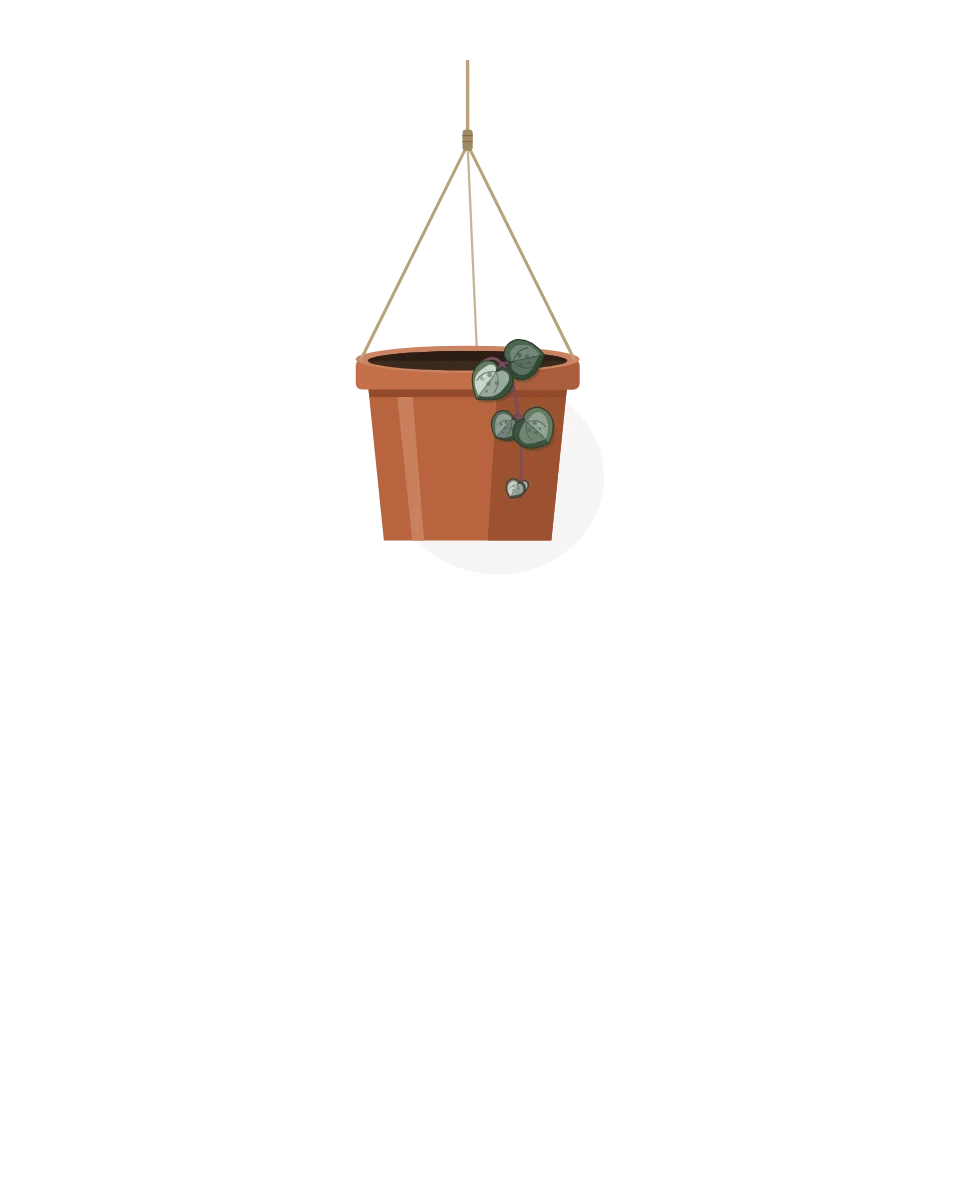
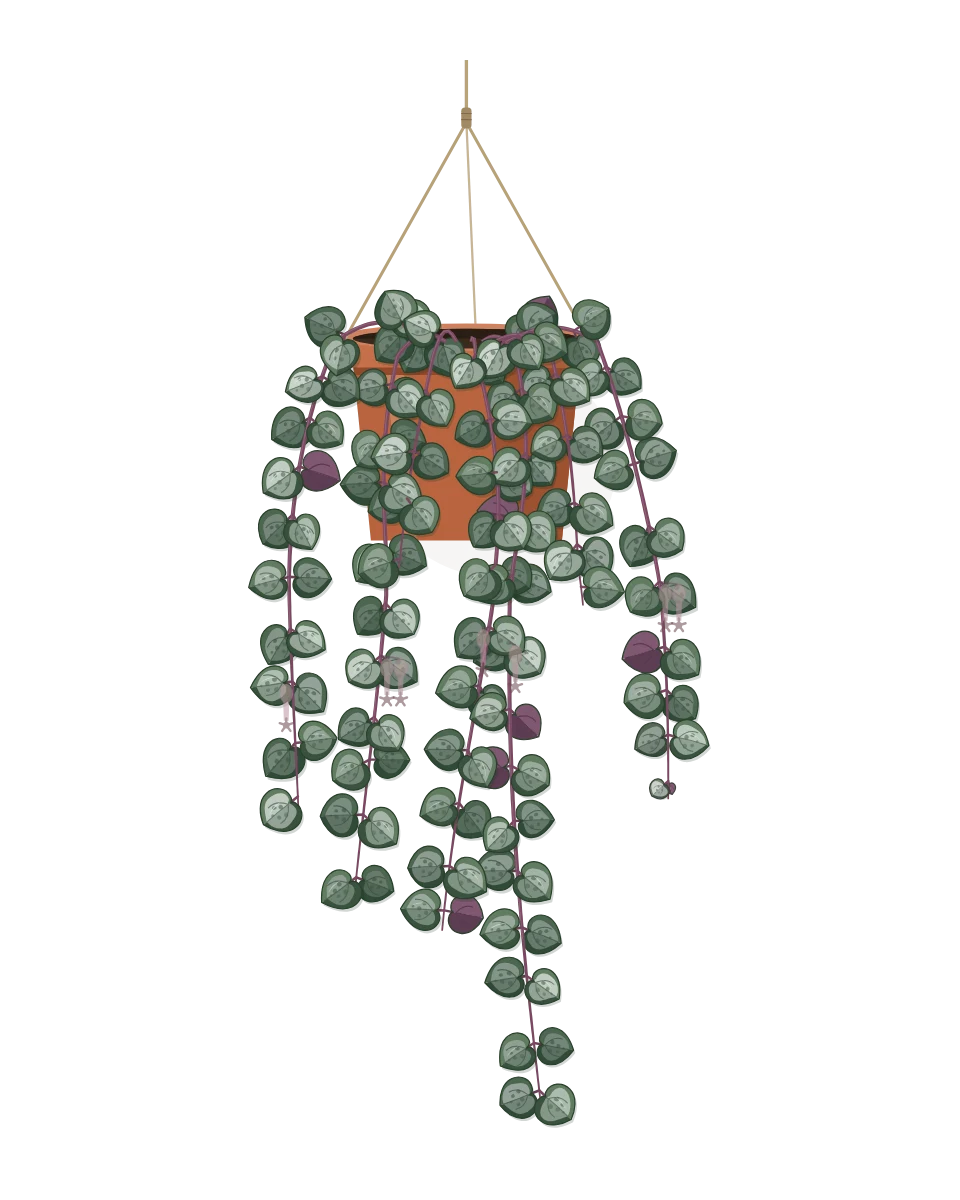
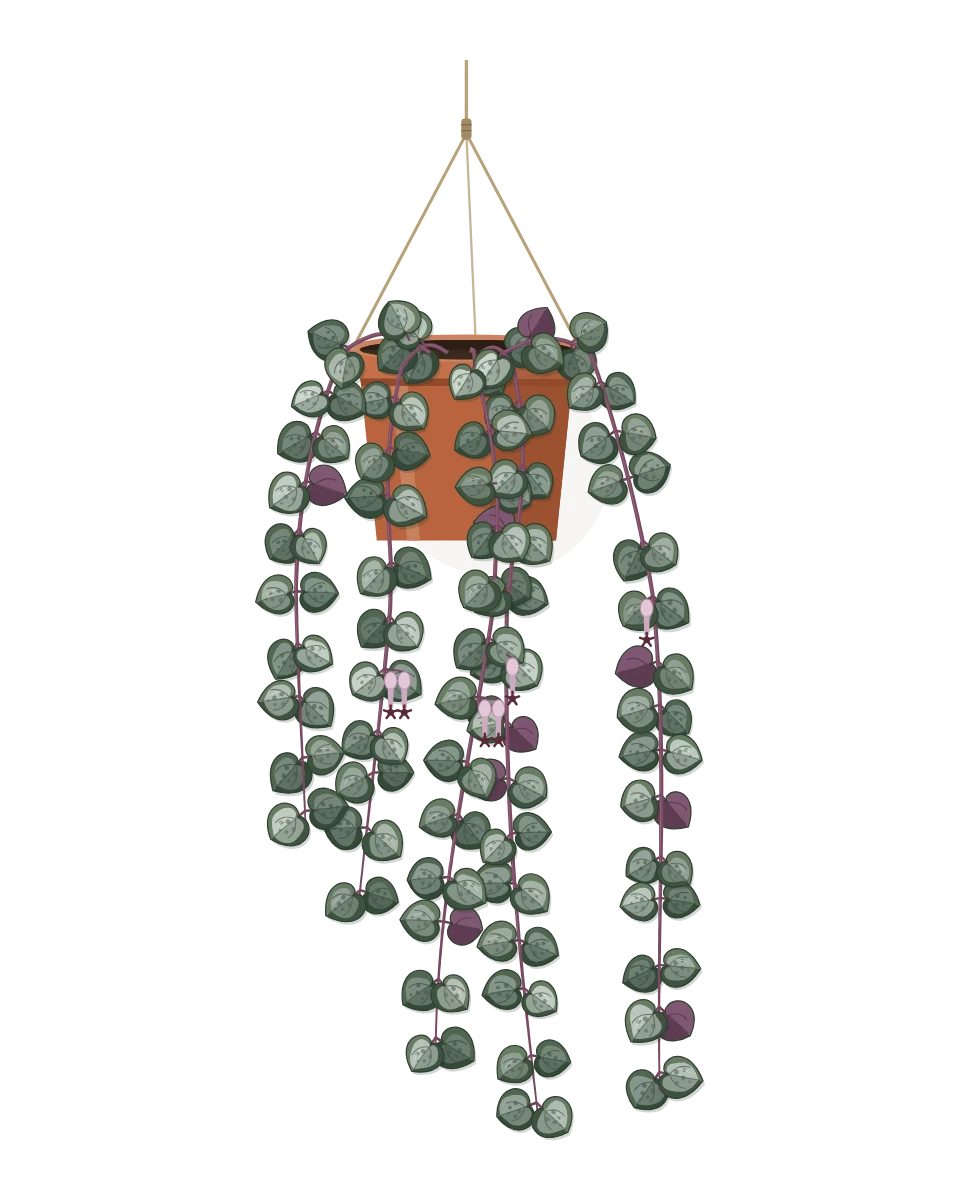
A trailing plant of wire-thin purple stems and small heart-shaped leaves, grey-green marbled with silver above and purple beneath, hanging a metre or more from a small pot (RHS profile, Wisconsin Horticulture). It comes from southern Africa, from Zimbabwe down to eastern South Africa, where it scrambles over rocks and through other plants in thin, dry, rocky soil (NC State Extension, Gardener's Path). John Medley Wood found it in 1881, and the species carries his name (Laidback Gardener). It is a close relative of the hoyas, in the same family, and like them it is a semi-succulent: the leaves thicken when they store water, a rounded tuber sits under the soil, and small round tubers form along the stems, the beads of its other name, rosary vine (Wisconsin Horticulture, HortFlora). The RHS gives it an Award of Garden Merit (RHS profile).
It is easy to live with. Every source that rates it calls it easy, low maintenance or a good first plant (NC State Extension, Epic Gardening, Plantura, Patch Plants). It tolerates dryness well and is easily killed by overwatering, which is nearly the whole of its care (Wisconsin Horticulture). No poison-centre list names it: the ASPCA has no entry for this plant or for any Ceropegia, Cats Protection lists it among plants safe for cats (Cats Protection), and growers call it non-toxic to pets and people (Gardener's Path, Laidback Gardener). Until that is settled, keep the strands where they cannot be chewed.
You buy it as a small pot of several rooted strands. What to expect in a year: fast growth in bright light, with the strands lengthening through spring and summer, new strands pushing up from the crown, a pause in winter, and in a good spot the first lantern flowers along the vines by the end of the summer (NC State Extension, Gardener's Path). The RHS puts it at two to five years to reach its full size (RHS profile).
Light
Bright light, close to a window. The extension pages say bright, indirect light with dappled sun (NC State Extension) or a west or south window (Wisconsin Horticulture); the RHS places it in partial shade at an east or west aspect (RHS profile); growers give it bright light plus a few hours of gentle direct sun, up to four, for the best colour (Gardener's Path, Laidback Gardener). The safe path is bright indirect light with morning or evening sun on the leaves, and hot midday sun through glass filtered by a sheer curtain (Epic Gardening). Move it into stronger light over a couple of weeks rather than in one go (Wisconsin Horticulture).
The leaves tell you what they are getting. In strong light the hearts come in dark, closely spaced and sharply marbled; in dim light they come in plain light green, small and far apart on long bare stretches of vine (Wisconsin Horticulture, NC State Extension, Gardener's Path). Too much sun shows as bleached or crispy scorched patches (NC State Extension). It manages in moderate light (Patch Plants), but in a dim room it slowly yellows and drops leaves (Laidback Gardener). Pick its spot early: the vines tangle when a hanging plant is turned or moved about.
Water
Check first. Push a dry finger as far into the mix as it will go, and lift the pot: learn what it weighs wet and dry (Laidback Gardener). Dry all the way down and light means it is time. Any dampness means wait. The leaves help: hearts that have gone thin, dull and slightly curled, or lower leaves beginning to wilt, are the plant asking (Epic Gardening, Laidback Gardener).
The rule: water thoroughly, until it runs out of the bottom, once the mix has dried out completely, then let it dry out again (NC State Extension, Wisconsin Horticulture). Deep and seldom, not in sips. A hanging pot is easiest to water by standing it in a bowl for half an hour and letting it drain for as long, which keeps water off the leaves (Laidback Gardener). Sources differ on how dry is dry: some say the top 5 cm (Laidback Gardener, Gardener's Path), one says do not let the root ball dry out completely (Plantura), and the extension pages say dry throughout. This guide takes the dry side: the tubers and leaves hold water, and overwatering is the one thing that kills this plant (Wisconsin Horticulture, Succulents and Sunshine).
Thirsty: thin, dull, wrinkled hearts on a dry, light pot. A soak brings them back over a day or two. Overwatered: yellow, soft or mushy leaves and stems, leaves dropping, growth stalling, all on a mix that is still wet (NC State Extension, Epic Gardening). If the leaves say thirsty and the soil says wet, believe the soil and look at the roots.
How often that lands depends on the pot, the mix, the light and the room. In a small pot of gritty mix in bright light in summer it often comes round about once a week (Gardener's Path), and in a cooler or larger setup every two weeks or so. In winter the plant rests and wants much less: a little water roughly every two weeks (Plantura) to once a month or less (Epic Gardening), depending on how warm the room is. The RHS puts it simply: water moderately while it is growing and keep it dry at other times (RHS profile). Treat the numbers as a reminder to go and check, not as the instruction.
Soil and pot
A gritty mix that drains in seconds. A cactus and succulent mix is the simplest (Wisconsin Horticulture, RHS profile); or open up a peat-free houseplant compost with a third or more of coarse perlite or sand (Wisconsin Horticulture, Plantura). Ordinary potting soil on its own stays wet too long (Epic Gardening). Slightly acid to neutral suits it (Gardener's Path, NC State Extension).
The roots are shallow, so a shallow pot is fine and a deep one is mostly wasted, wet mix (Epic Gardening). It needs a drainage hole, and a small pot: it does best when crowded, and a confined root run can even bring on flowers (Wisconsin Horticulture, Epic Gardening). Unglazed terracotta breathes and dries fastest, which forgives an extra watering (Laidback Gardener); a plastic nursery pot inside a hanging cachepot also works, as long as the cachepot is emptied after each watering. A new plant usually arrives in a 12 cm pot (Patch Plants) and can stay there for its first year or two.
Repot rarely, in spring before new growth starts, and only when the tubers and roots have filled the pot: roots at the drainage hole, the plant lifting itself, a mix that dries far faster than it used to (Wisconsin Horticulture, Epic Gardening). Every two or three years is usual (Gardener's Path). Go up one size only, 2 to 4 cm wider, planted at the same depth (Gardener's Path, Epic Gardening). Repot into dry mix and hold the water for a few days so any broken roots and bruised tubers can seal before they meet moisture; this is the usual practice for succulents, and the cautious side for a plant whose base rots when wet. No feed for six weeks after.
Feeding
Lightly, and not often. A balanced liquid houseplant feed or a cactus and succulent feed at half strength, at most once a month from spring to early autumn (Wisconsin Horticulture, Patch Plants, Gardener's Path). Nothing from late autumn to late winter, when the plant is resting and salts would only build up in the mix (Wisconsin Horticulture, Laidback Gardener). Sources range from two or three low-nitrogen feeds a season (RHS profile) to monthly (Plantura) to none at all unless the pot is years old (Epic Gardening). Too much feed makes the hearts drop (Epic Gardening), so this guide takes the weak end, and a monthly half dose is already the most it needs.
Flowering
It flowers readily indoors once it is settled in good light. The flowers are small lanterns about 2 cm long, held along the vines: a swollen base in white to pale pink or lilac, a slender tube, and five dark purple lobes fused at the tip into a hairy little cage (RHS profile, Wisconsin Horticulture, HortFlora). The cage is a trap: tiny flies crawl in past downward-pointing hairs, are held until the hairs wilt, and leave carrying pollen (Wisconsin Horticulture). Indoors you will rarely see that, and the plant is not carnivorous (NC State Extension). The main season is summer into autumn, with odd flowers at other times (NC State Extension, Wisconsin Horticulture).
What it takes: bright light with some gentle sun, a snug pot, a drier and unfed winter, and a light feed in spring (Epic Gardening, Wisconsin Horticulture). A plant that will not flower is nearly always short of light. There is no spur to protect, as there is on a hoya; let spent flowers drop by themselves. A pollinated flower can set a slender horn-shaped seed pod that splits to release flat seeds on silky parachutes (Wisconsin Horticulture).
When something looks wrong
Look at the soil first; nearly all trouble on this plant is water or light.
- Thin, dull, curled or wrinkled hearts. Check the mix. Dry and light: soak it through and the hearts plump up over a day or two. Wet: the roots are damaged; let it dry out completely and slide it out to look at the roots and tubers (Epic Gardening, Laidback Gardener).
- Yellow, soft leaves on wet mix. Overwatering, a pot too large, or a mix that holds water. Stop until dry throughout, check that water runs freely out, and repot into fresh gritty mix in a snug pot if the mix stays soggy (NC State Extension, Plantura).
- Mushy stems, dark soft base, wilting on wet mix. Root and tuber rot, the one disease it really gets, and the RHS names basal rot from winter wet in particular (RHS profile, Gardener's Path). Cut away every dark soft root and any mushy tuber, let the healthy parts dry for a day, repot in fresh dry mix, and take cuttings of healthy vine straight away in case the plant does not recover.
- Long bare stretches, small pale hearts far apart. Too little light (NC State Extension, Gardener's Path). Move it closer to a bright window over a couple of weeks. In spring, trim the bare lengths back and root them.
- Marbling faded to plain green. Also light (Wisconsin Horticulture). The old hearts stay as they are; the new ones come in marbled once the light is better.
- Bleached, crispy or brown patches. Sunburn, usually hot midday sun through glass or a sudden move outdoors (NC State Extension, Plantura). Move it back or filter the light; the marks stay, new growth comes clean.
- Leaves dropping. Too little light, too much water, too much feed, or cold on a windowsill (Laidback Gardener, Epic Gardening). Check the mix and correct it, give more light, stop feeding for the season, and keep it above 15 C.
- Small round beads on the vines. Aerial tubers. Normal, and the reason for the name rosary vine (Wisconsin Horticulture). Leave them, or press one onto moist mix for a new plant.
- Tangled vines. A hanging plant that is turned or brushed past knots itself. Settle on a spot, tease the strands apart gently when the plant is dry, and trim the longest and root them. Take no more than a third of the plant at once (Epic Gardening).
- No flowers. Light first, then the pot: a plant in a pot too large or fed too much puts its effort into leaves (Epic Gardening). Give it a drier, unfed winter and a bright summer, and wait a year.
- Mealybugs. White cottony tufts in the leaf joints and along the stems, the pest most sources mention (Wisconsin Horticulture, RHS profile). Dab each one with a cotton bud in rubbing alcohol, wash with insecticidal soap, repeat weekly for several weeks, and keep the plant apart until clear (Clemson HGIC).
- Aphids. Small green or black insects on the growing tips (NC State Extension). Rinse or wipe them off, spray with insecticidal soap and repeat a few times (Clemson HGIC).
- Scale. Small hard brown bumps with sticky residue (RHS profile). Scrape them off with a fingernail, spray the crawlers with insecticidal soap and repeat (Clemson HGIC).
- Spider mites. Pale speckling and fine webbing in warm dry air (Laidback Gardener). Rinse the plant, undersides included, every few days and spray with insecticidal soap about once a week for several weeks (Clemson HGIC).
Propagation
This is one of the easiest plants to pass on, and the easiest way to make a thin plant full. In spring or early summer, cut 10 to 15 cm lengths of vine with at least one or two pairs of leaves and push them back into the parent pot, the end nearest the rim going into the mix; a skewer makes the hole (New York Botanical Garden, RHS profile). Keep the mix just moist and warm, 22 to 25 C, and roots usually form within a few weeks; a cutting under a clear bag roots in about two to three weeks, a vine simply pinned to the surface in up to four (RHS profile, Gardener's Path). Growers who prefer the dry way let the cut end callus for two or three days first and set it on barely moist mix (Laidback Gardener, Succulents and Sunshine). Cuttings also root in a jar of water (Gardener's Path).
The beads work too. Press an aerial tuber half into moist mix, ideally while it is still attached to the vine, keep it just moist, and cut it free once it has rooted and started to grow (Wisconsin Horticulture, NC State Extension). A single heart on its own will not make a plant; take a piece of stem with it. Seed is possible from a pollinated pod, sown on the surface in warmth, but cuttings and tubers are quicker and come true (RHS profile, Gardener's Path). Give the new plant the same light and the same dry spells as its parent, and wait two or three months before feeding it.
Grow one for a habit
In Hoya Habit, every habit you keep grows a plant of its own. Check in and it leafs out; let it slide and the plant shows it. Give one of your habits a Ceropegia woodii.
Sources
- NC State Extension, Ceropegia woodii, read 2026-10-21
- RHS, Ceropegia linearis subsp. woodii plant profile, read 2026-10-21
- Wisconsin Horticulture (UW-Madison Extension), String of Hearts, read 2026-10-21
- New York Botanical Garden, Can you offer advice on how to propagate string of hearts, read 2026-10-21
- Clemson HGIC 2252, Common Houseplant Insects and Related Pests, read 2026-10-21
- Cats Protection, Cats and indoor plants, read 2026-10-21
- Royal Botanic Gardens Victoria, HortFlora, Ceropegia woodii, read 2026-10-21
- Laidback Gardener, How to properly care for Ceropegia woodii, read 2026-10-21
- Epic Gardening, How to plant, grow and care for string of hearts, read 2026-10-21
- Gardener's Path, How to grow and care for string of hearts, read 2026-10-21
- Patch Plants, Complete guide to Ceropegia woodii care, read 2026-10-21
- Plantura, String of hearts care, flower and propagation, read 2026-10-21
- Succulents and Sunshine, Ceropegia woodii variegata, read 2026-10-21