 Hoya Habit
Care guide
String of pearls (Curio rowleyanus)
Also called String of beads, Senecio rowleyanus, Bead plant, Rosary plant. Family Asteraceae.
At a glance
- Light
- Bright, indirect light; copes with some direct sun.
- Water
- When the mix has dried right through. Check the soil first.
- Soil
- A gritty, fast-draining cactus and succulent mix, or a peat-free loam-based compost cut with a third to a half of coarse sand, grit or pumice.
- Pot
- A drainage hole is a must; likes to be snug; go up 2 to 4 cm at a time.
- Temperature
- 18 to 27 C; not below 10 C.
- Humidity
- 30 to 50%; ordinary room air is fine.
- Feeding
- Half strength every 4 to 8 weeks in the growing season, none in the rest months.
- Repotting
- Every 2 to 3 years, in spring.
- Rest
- Late autumn to late winter: cooler, drier, unfed.
- Flowers
- Spring to summer, on a settled plant in good light.
- Pets and people
- Cats toxic, dogs toxic, people mildly irritating.
- Difficulty
- Moderate.
Before you waterPush a dry finger as far into the mix as it will go and lift the pot. Dry throughout and light means water; any dampness means wait. Pearls that have gone slightly flat and wrinkled are the plant asking.
Meet the plant
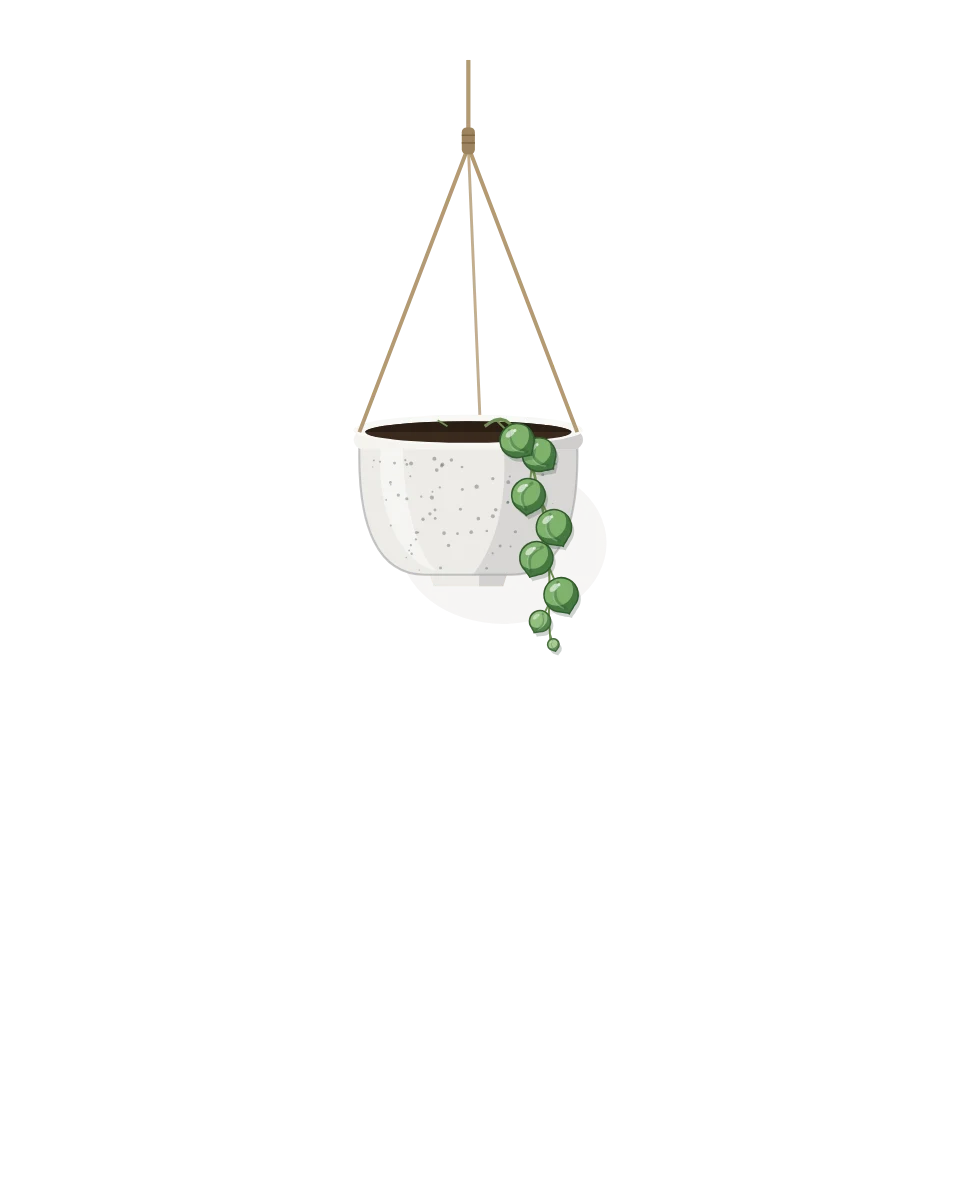
A trailing succulent of thread-thin stems strung with pea-sized green pearls, hanging 60 to 90 cm from a small pot (Wisconsin Horticulture, NC State Extension). Each pearl is a leaf rolled into a ball to save water, with a tiny point at the tip and a thin translucent stripe down one side, a window that lets light into the leaf (Wisconsin Horticulture). It comes from the dry eastern Cape of South Africa, where it creeps along the ground in the shade of bushes and rocks, rooting wherever a stem touches soil (NC State Extension, Wisconsin Horticulture). It is a daisy, not a hoya, and botanists moved it from Senecio to Curio; most shops still sell it as Senecio rowleyanus (Wisconsin Horticulture). The RHS gives it an Award of Garden Merit (RHS profile).
It has a reputation. The RHS and Epic Gardening call it easy, and it is, in the sense that it asks for very little (RHS growing guide, Epic Gardening). But NC State calls it very particular about its conditions, growers call it tricky, and the reason is always the same: it is more sensitive to overwatering than almost any other succulent, and a wet pot kills it quietly from the roots up (NC State Extension, Succulents and Sunshine, Plantura). The strands are also fragile and shed pearls when handled (RHS growing guide). Once you water it by the soil and the pearls instead of by the calendar, it is a calm plant. It is toxic to cats and dogs and mildly so to people, and the sap can irritate skin (ASPCA, NC State Extension, RHS profile); hanging it high keeps it out of reach.
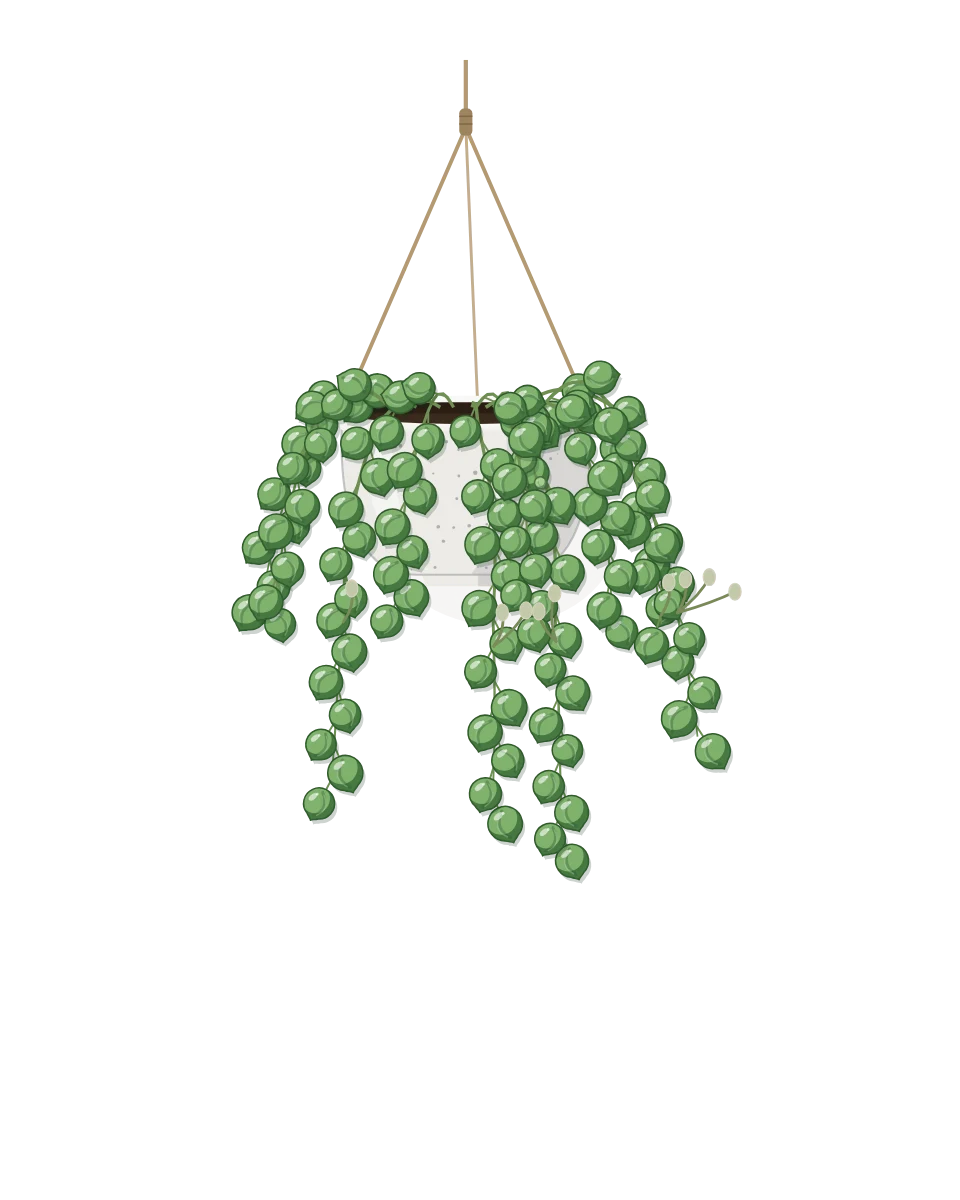
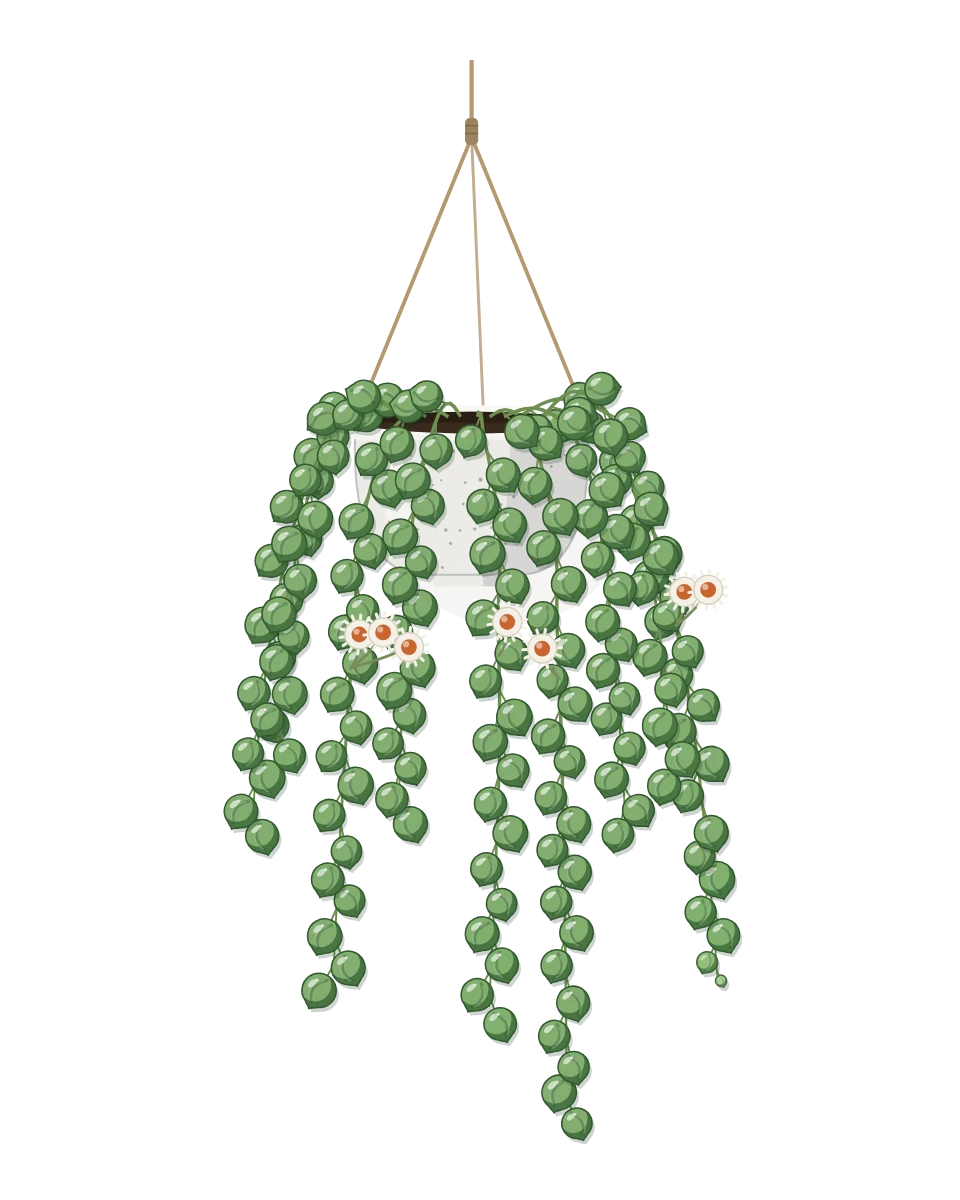
You buy it as a small pot of rooted strands. What to expect in a year: quick growth in bright light, the strands lengthening over the rim through spring and summer, a pause in a cool winter, and perhaps a few cinnamon-scented flowers in spring or summer if the winter was cool and dry (Epic Gardening, Gardeners' World). The RHS puts it at one to two years to full size (RHS profile). It is not a long-lived plant: a pot tends to thin and die back after a few years, three to five by one account, and growers keep it going by rooting cuttings from the healthy strands (NC State Extension, Almanac).
Light
Bright light, close to a window: an east or west window suits it, and in summer keep it out of hot midday sun, so a south window is better with the plant set back or behind a sheer curtain (RHS growing guide, Epic Gardening). Sources differ on how much sun: NC State says bright indirect light indoors, the RHS profile asks for several hours of direct sun, and growers settle on morning sun with filtered light in the afternoon (NC State Extension, RHS profile, Almanac). The safe path is bright indirect light with a few hours of gentle sun, introduced over a couple of weeks (Wisconsin Horticulture). It wants a good six hours of bright light a day (Plantura, Almanac).
Too little light shows as long stretches of bare thread with small, pale pearls far apart, and weak straggly strands (RHS growing guide, Mountain Crest Gardens). Too much shows as brown, crispy, scorched pearls on the sunny side (RHS growing guide, NC State Extension), and sometimes a purple flush, which is stress colour and fades (Mountain Crest Gardens). The strands grow toward the light and away from the pot, so turn it now and then or the crown goes bald.
Water
Check first. Push a dry finger as far into the mix as it will go, and lift the pot: learn what it weighs wet and dry (Gardeners' World). Dry all the way down and light means it is time. Any dampness means wait. Then look at the pearls: when they go slightly flat and wrinkled, like raisins, the plant has used its stored water and is ready for a good soak (Wisconsin Horticulture, Mountain Crest Gardens). This is the plant's own gauge, and it is reliable.
The rule: water thoroughly, until it runs out of the bottom, once the mix has dried out completely, then let it dry out again (Wisconsin Horticulture, Epic Gardening). The easiest way with a hanging pot is from below: stand it in a shallow dish of water for half an hour, then let it drain, so the crown and the pearls stay dry (Gardeners' World, Almanac). Keep water off the pearls and empty any saucer or cachepot (RHS growing guide). Sources differ on how dry is dry: NC State says never let it dry out completely, the RHS and Gardeners' World say the top 2 to 3 cm, and Wisconsin, Epic Gardening and the succulent growers say completely (NC State Extension, RHS growing guide, Succulents and Sunshine). This guide takes the dry side, because a thirsty pearl wrinkles and recovers, and a drowned one bursts and does not; it is better to underwater this plant than to overwater it (Gardeners' World).
Thirsty: pearls flat, wrinkled and dull on a dry, light pot. A soak plumps them within a day or two (Epic Gardening, Plantura). Overwatered: pearls turning yellow and glassy, then soft, bursting or dropping at a touch, stems going brown or black and mushy, all on a mix that is still wet (Succulents and Sunshine, Gardeners' World, Almanac). Shrivelled pearls on wet mix mean the roots have rotted and can no longer drink; believe the soil, not the pearls, and look at the roots.
How often that lands depends on the pot, the mix, the light and the room. In a small shallow pot of gritty mix in bright light in summer it often comes round every other week, and in a cooler room or a larger pot every three weeks or so (Epic Gardening, Gardeners' World, Almanac). In winter the plant rests and wants very little, roughly once a month, and only enough to stop the pearls shrivelling (Plantura, RHS growing guide). Treat the numbers as a reminder to go and check, not as the instruction; the pearls will tell you.
Soil and pot
A gritty mix that drains in seconds. A peat-free cactus and succulent compost is the simplest (RHS growing guide, NC State Extension); or mix two parts loam-based peat-free compost with one part horticultural grit (RHS growing guide). Succulent growers go grittier still, up to half sand, pumice or grit (Wisconsin Horticulture, Mountain Crest Gardens). Do not make a home mix rich (Epic Gardening). Slightly acid to neutral suits it (NC State Extension).
The roots are weak, small and shallow, so the pot should be shallow too: a bowl or a squat pot with a drainage hole, holding only a few centimetres of mix (Wisconsin Horticulture, Plantura). A deep or oversized pot holds wet mix the roots never reach, and that is where rot starts (Epic Gardening). Terracotta is the material most sources prefer, because it draws water out of the mix and dries faster than plastic or glazed pots (Wisconsin Horticulture, RHS growing guide); a plastic nursery pot in a hanging cachepot works if the cachepot is emptied after every watering. Choose a pot only slightly larger than the root ball (RHS growing guide, Gardeners' World).
Repot rarely, in spring, and only when roots come out of the drainage hole, the mix dries far faster than it used to, or it has gone dark and saturated (RHS growing guide, Plantura). A new plant can stay in its pot for at least a year; after that every two or three years is usual (RHS growing guide, Almanac), though sources range from yearly (Epic Gardening) to every three or four (Mountain Crest Gardens). Go up one size, 2 to 4 cm wider, and plant at the same depth. Use dry mix and keep it dry for a few days after, so broken roots seal before they meet moisture (Epic Gardening), and hold the feed for a couple of months; Plantura holds it for a year. Lift the plant by the pot, never by the strands, and untangle it only when it is dry: the pearls drop at a touch (Almanac).
Feeding
Lightly. A balanced liquid houseplant feed or a cactus and succulent feed at half strength, at most once a month from spring to early autumn (RHS growing guide, Epic Gardening, Almanac). Nothing from late autumn to late winter (Almanac). It is not a hungry plant: Wisconsin feeds once lightly in spring, Plantura every eight weeks with a cactus feed and not at all for a year after repotting, Mountain Crest only when growth has stalled for months (Wisconsin Horticulture, Plantura, Mountain Crest Gardens). The monthly half dose is the most it needs, and less does no harm. Put the feed on the mix, not the pearls (Epic Gardening).
Flowering
The flowers are small white fluffy heads, like tiny paintbrushes or pompoms about a centimetre across, with long red stamens and yellow anthers, held on short stalks off the strands, and they smell of cinnamon (NC State Extension, Wisconsin Horticulture, RHS profile). They are not showy, but the scent is worth it. They come in spring or summer (Gardeners' World, RHS profile), and last around a month (Epic Gardening).
Sources disagree on how likely they are indoors: NC State and the Almanac say it rarely flowers inside, while the RHS, Gardeners' World, Plantura and Epic Gardening all expect flowers after one thing, a cool winter (NC State Extension, Almanac). What it takes: bright light with some gentle sun through the year, a snug pot, and from late autumn to late winter a cooler room at 13 to 16 C, very sparing water and no feed (RHS profile, Gardeners' World, Plantura, Gardenista). A plant kept warm and watered all winter grows on quietly and does not bloom. There is no spur to protect; the spent heads can be snipped off once they dry (Mountain Crest Gardens).
When something looks wrong
Look at the soil first, then at the pearls. Nearly everything that goes wrong with this plant is water.
- Wrinkled, flat, dull pearls. Check the mix. Dry and light: soak it through and they plump up within a day or two. Wet: the roots are rotting; let it dry out completely and slide it out to look (Epic Gardening, Almanac). Shrivelling only on the sunny side is sunburn (Epic Gardening).
- Yellow, glassy, soft or burst pearls, dropping at a touch. Overwatering, or a pot too large or too deep. Stop until dry throughout, check that water runs freely out, remove the damaged pearls and any soft stem, and repot into fresh dry gritty mix in a shallow snug pot if the old mix stays soggy (Succulents and Sunshine, Gardeners' World, Epic Gardening).
- Brown or black mushy stems, strands collapsing. Root and stem rot, the one disease it really gets (RHS growing guide, NC State Extension). Cut away every dark soft root and stem, let the healthy parts dry for a day, repot in fresh dry mix, and take cuttings of healthy strand straight away: a plant this far gone is often only saved as cuttings (Epic Gardening, Almanac).
- Long bare thread, small pale pearls far apart. Too little light (RHS growing guide, Mountain Crest Gardens). Move it closer to a bright window over a couple of weeks, turn the pot, and lay the trimmed bare lengths on the mix to root.
- Brown, crispy or scorched pearls on one side. Sun through glass or a sudden move into stronger light (RHS growing guide, Plantura). Move it back or filter the light; the marks stay, new growth comes clean.
- Pearls dropping when touched. Mostly normal fragility; also a cold draught or windowsill, or overwatering (Gardeners' World, Epic Gardening). Handle it by the pot, keep it off cold glass, and check the mix.
- A purple or magenta flush. Stress colour from strong sun or drought, harmless on its own (Mountain Crest Gardens). Check the mix, shade it from midday sun, and it fades.
- Bald crown, everything hanging below the rim. The strands grow toward the light and the oldest growth ages out at the top. Turn the pot regularly, and trim the longest strands and lay the pieces across the mix, where they root and fill the crown (Mountain Crest Gardens, Epic Gardening).
- Sticky stems with no insects. A harmless secretion of its own; check closely for mealybugs and scale, and if there are none, leave it (Mountain Crest Gardens).
- An old plant thinning out despite good care. It is a short-lived plant in a pot and tends to die back after a few years (NC State Extension, Almanac). Take cuttings and start again; that is how growers keep one going.
- No flowers. A warm, watered winter is the usual reason, then light (Gardeners' World, Epic Gardening). Give it a cool, dry, unfed winter and a bright summer, and wait a year.
- Mealybugs. White cottony tufts among the pearls, the most common pest and easy to miss (Mountain Crest Gardens, Wisconsin Horticulture). Dab each one with a cotton bud in rubbing alcohol, wash with insecticidal soap, repeat weekly for several weeks, and keep the plant apart until clear (Clemson HGIC).
- Aphids and whitefly. Small insects on the growing tips, or tiny white flies that rise when the plant is disturbed (RHS profile, NC State Extension). Rinse or wipe them off, spray with insecticidal soap and repeat a few times (Clemson HGIC).
- Spider mites. Pale speckling and fine webbing in warm dry air (RHS profile, Almanac). Rinse the plant every few days and spray with insecticidal soap about once a week for several weeks (Clemson HGIC).
- Fungus gnats. Tiny black flies around the pot mean the mix is staying damp (Plantura, Almanac). Let it dry out completely between waterings, and repot into fresh dry mix if the old one has broken down.
Propagation
The easiest part, and the way to keep the plant going. In spring or summer, cut healthy 8 to 12 cm lengths of strand with clean scissors, wearing gloves for the sap, and let the cut ends dry for a day or two (Gardeners' World, Almanac, Succulents and Sunshine). Then either strip the lowest few pearls and push the bare stem into a pot of barely moist gritty mix, or simply lay the strand on the surface of the mix, coiling it and pinning it down, and roots form at the nodes wherever a stem touches the soil (Wisconsin Horticulture, RHS growing guide, Mountain Crest Gardens). Keep it in bright indirect light and mist only the surface of the mix every few days until it has taken; roots usually come in three or four weeks (Gardeners' World, Almanac). Laying cuttings across the top of the parent pot is also how you keep an older plant full at the crown. A strand can be layered too: pin it to a pot of mix beside the plant and cut it free once it has rooted (RHS growing guide).
A single pearl laid on soil may root but is slow and unreliable; take a length of stem (NC State Extension). Seed is possible but rarely available and slow (Wisconsin Horticulture, Epic Gardening). Give the new plant the same light and the same dry spells as its parent, and wait two or three months before feeding it.
Grow one for a habit
In Hoya Habit, every habit you keep grows a plant of its own. Check in and it leafs out; let it slide and the plant shows it. Give one of your habits a Curio rowleyanus.
Sources
- NC State Extension, Curio rowleyanus, read 2026-10-21
- RHS, Curio rowleyanus plant profile, read 2026-10-21
- RHS, How to grow string of beads, read 2026-10-21
- Wisconsin Horticulture (UW-Madison Extension), String of Pearls, read 2026-10-21
- ASPCA, Are succulents safe to have around pets, read 2026-10-21
- Clemson HGIC 2252, Common Houseplant Insects and Related Pests, read 2026-10-21
- Epic Gardening, How to plant, grow and care for string of pearls, read 2026-10-21
- BBC Gardeners' World, How to grow string of pearls, read 2026-10-21
- Plantura, String of pearls care, read 2026-10-21
- The Old Farmer's Almanac, How to care for string of pearls, read 2026-10-21
- Mountain Crest Gardens, How to grow an epic string of pearls plant, read 2026-10-21
- Succulents and Sunshine, Senecio rowleyanus string of pearls, read 2026-10-21
- Gardenista, Gardening 101, String of pearls, read 2026-10-21